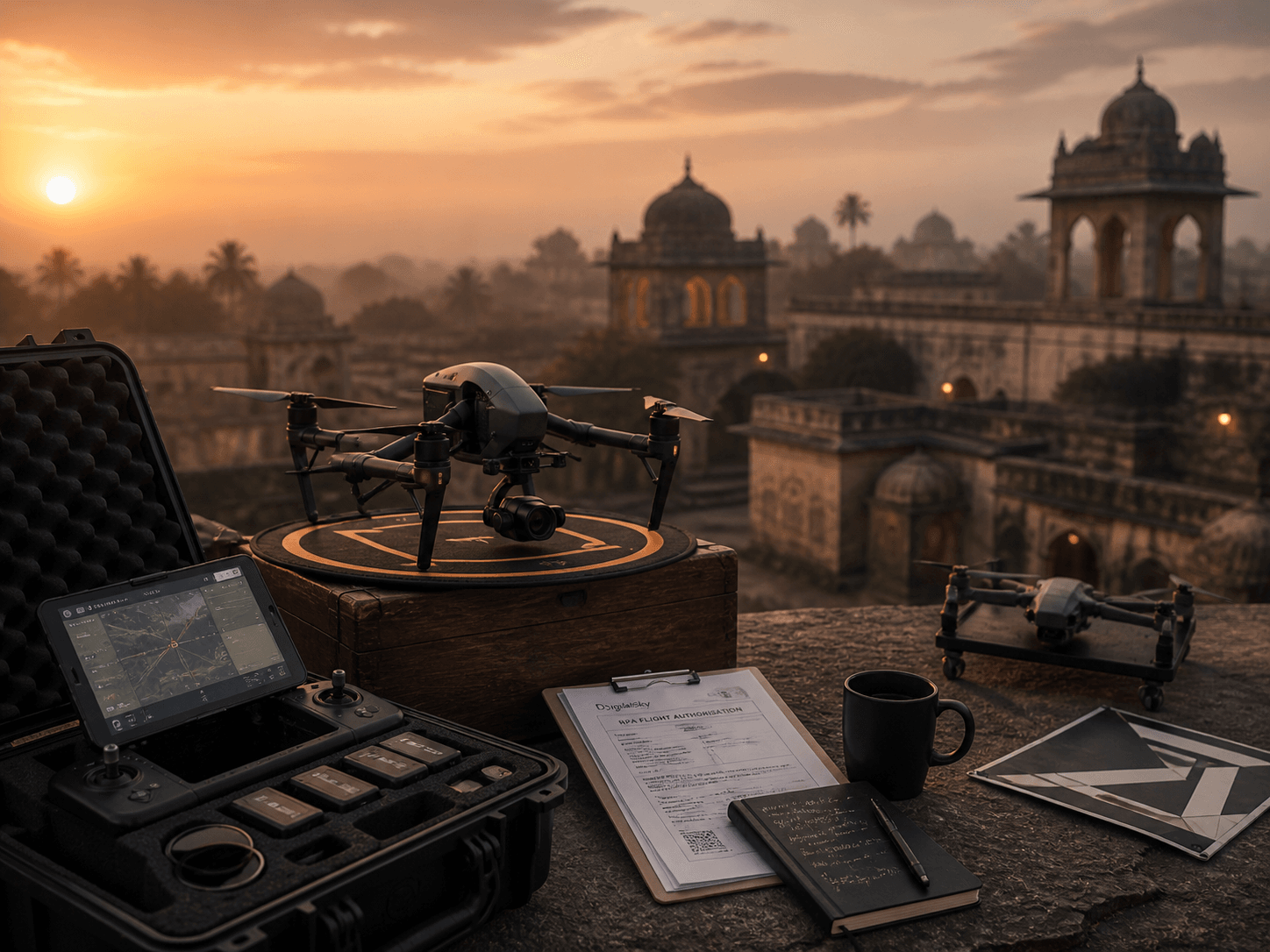
Drone Videography in India: Costs, DGCA Rules, and When You Actually Need It (2026)
Drone videography in India has moved from premium add-on to standard production tool in less than five years. Grand View Research values the India drone market at USD 1.58 billion in 2024 and projects it to grow at 20.4% CAGR to reach USD 4.84 billion by 2030. The media and entertainment segment alone accounted for over 21% of global commercial drone revenue in 2024 and continues to grow steadily. For Indian brands producing weddings, real estate, hospitality, brand films, or event content, the question is no longer whether to use drone but when, how legally, and at what cost. This guide walks through DGCA rules, working price tiers, when drone videography earns its place in a production, and how to choose a qualified operator.
Why Drone Videography Has Become Standard in 2026
Three structural shifts explain why drone videography has gone mainstream in Indian commercial production.
Per Grand View Research’s India drone market outlook, the market is on track to triple between 2024 and 2030, growing from USD 1.58 billion to USD 4.84 billion at a 20.4% CAGR. MarketsandMarkets projects drone unit volume in India to grow from 10,803 units in 2024 to 61,393 units by 2029. The commercial drone segment, which includes videography and filmmaking, is one of the fastest-growing slices.
The first shift is hardware. Cinema-quality drones that cost ₹15 lakh in 2018 are now available in the ₹3 to ₹6 lakh range, and the entry-level professional drones have collapsed to under ₹1.5 lakh while delivering 4K and 5.1K cinema-grade output. The DJI Mavic and Inspire series, alongside FPV systems from custom Indian builders, now match what Hollywood crews used a decade ago.
The second shift is regulatory. The Drone Rules 2021, combined with the DigitalSky platform, gave India one of the most workable commercial drone frameworks in Asia. Permission applications that used to take weeks are now processed in days, sometimes hours, when the application is clean and the airspace is green-zone.
The third shift is audience expectation. After ten years of cinematic Indian wedding films, real estate walkthroughs, and brand films using aerials, audiences now register the absence of drone footage. A wedding film without drone, a hotel brand film without an aerial, a real estate listing without a sky-shot of the property all feel incomplete to a 2026 viewer. Aerial perspective has become part of the visual grammar of modern commercial video.
DGCA Drone Rules in India: What Every Brand Should Know
The Directorate General of Civil Aviation (DGCA) regulates all drone operations in India under the Drone Rules 2021. Brands hiring drone videography services should know enough about the framework to verify their operator is compliant. The penalties for non-compliance now reach up to ₹1 lakh per violation under the proposed 2025 amendment, and footage shot illegally cannot be used commercially.
Drone weight categories. The DGCA classifies drones by maximum all-up weight including payload. Each category has different registration and licensing requirements.
- Nano (under 250 grams). No registration, no Unique Identification Number, no Remote Pilot Certificate required for non-commercial use. Examples include hobbyist micro-drones.
- Micro (250 grams to 2 kilograms). Registration on DigitalSky required. UIN must be physically marked on the drone. Remote Pilot Certificate required for any commercial use, including videography.
- Small (2 kg to 25 kg). Full registration and UIN required. Remote Pilot Certificate or Remote Pilot Licence is mandatory for any operation. Most professional cinema drones used by Indian production studios sit in this category.
- Medium (25 kg to 150 kg) and Large (over 150 kg). Industrial-grade drones used for inspection, surveying, and heavy lift. Rarely used for videography.
Airspace zones. India is divided into three colour-coded zones on the DigitalSky platform.
- Green Zone. Open to fly without prior permission for drones up to 400 feet altitude. Covers most rural and semi-urban areas away from sensitive infrastructure.
- Yellow Zone. Controlled airspace requiring prior permission through DigitalSky. Includes areas within a defined radius of airports, sensitive sites, and certain urban zones.
- Red Zone. No-fly. Includes airports within prescribed radius, military installations, international borders, and other strategic locations. Flying here is prohibited and prosecutable.
For commercial drone videography, the operator must hold a valid Remote Pilot Certificate, the drone must be registered with a UIN, third-party insurance must be in place (mandatory for all categories above nano), and yellow-zone shoots need prior permission filed at least one to two weeks in advance. Hobby flying at night and beyond visual line of sight remain restricted in 2026.
Brands can verify their drone operator’s compliance by checking the UIN displayed on the drone, confirming the operator’s RPC, and asking which zone the shoot location falls under on the DGCA DigitalSky platform. A studio that cannot answer these questions cleanly is not the studio to fly for your project.
What Drone Videography Costs in India in 2026
Drone videography in India in 2026 is priced either as an add-on to a wider production (most common) or as a standalone aerial shoot. The price depends on the drone class, pilot rating, location category, shoot duration, and post-production load.
The chart shows working cost bands for drone videography across five common project types in India in 2026. Most drone work is bundled inside a wider shoot, where the marginal cost is small. Standalone aerial campaigns with full DGCA permissions, multi-day shoots, and cinema-grade equipment carry the heaviest cost.
- Drone add-on to wedding or event coverage (₹10,000 to ₹25,000). One-day single-pilot drone, basic 4K capture, edit integrated into the main wedding film. The most common drone engagement in India.
- Drone add-on to brand or commercial shoot (₹25,000 to ₹75,000). Higher-spec drone (DJI Mavic 3 Cine or Inspire 3), single shoot day, on-set creative direction integrated with the cinema team. Standard inclusion in mid-tier brand films and corporate videos.
- Standalone aerial shoot for real estate (₹35,000 to ₹1 lakh). Half-day or full-day shoot, multiple property angles, exterior aerial coverage, stitched edit. Standard for premium real estate listings, hospitality, and resort marketing.
- Cinema-grade drone with FPV pilot (₹75,000 to ₹2 lakh). RED, ARRI, or full-frame mirrorless cameras mounted on heavy-lift drones, FPV style runs through architectural spaces, custom rigging. The format used in premium brand films and music videos.
- Multi-day aerial campaign with full permissions (₹2 lakh to ₹6 lakh). Two to three shoot days, multiple locations, yellow-zone permissions filed and approved, drone team plus ground crew, full post-production and colour grade. The kind of aerial work commissioned for tourism boards, large-scale resort campaigns, and national brand films.
Yellow-zone permissions can add ₹15,000 to ₹50,000 to a project depending on location and lead time. Hill-station, beach, and rural shoots are usually green-zone and need no permission. Goa, Mumbai, parts of Bangalore, and most major metro centres are yellow-zone and need filing.
When You Actually Need Drone Videography
Drone is now standard, but it is not always essential. Knowing when drone earns its place in a production saves budget and keeps the film tight.
Drone is essential for:
- Real estate and architecture. Aerial walkthroughs of properties, projects, and developments are now expected, not premium. The geography of a property cannot be communicated without aerial.
- Hospitality, hotels, and resorts. Aerial of the property in its setting is the single most powerful shot in any hospitality brand film. Coast, hill, jungle, lake, and desert resorts all gain dramatically from drone.
- Wedding films at heritage venues, palaces, and outdoor settings. Aerial shots of the venue, the baraat procession, and the scale of the celebration give wedding films their most cinematic moments.
- Tourism, travel, and destination films. Showing scale, geography, and the layered beauty of a place is what drone does best.
- Large-scale events and festivals. The scale of a music festival, sports event, or brand activation is only visible from the air.
Drone is usually unnecessary for: indoor product videos, talking-head testimonials, founder interviews, studio-shot brand films, and most explainer content. Adding drone to these projects often signals a studio padding the budget rather than serving the film.
The honest test for whether drone earns its place in a project is to ask whether the film loses something specific without aerial. If the answer is yes, drone is essential. If the answer is just “it would look nice,” it is probably money better spent on a stronger script or an extra shoot day on the ground.
How to Choose a Drone Videography Operator
Six checks help separate a qualified drone operator from a hobbyist with a DJI Mini.
- Verify DGCA compliance. Ask for the operator’s Remote Pilot Certificate number and the drone’s UIN. A serious commercial operator will share both immediately. Anyone who hesitates is not the right partner.
- Confirm third-party insurance. Insurance is mandatory for all categories above nano. Confirm the policy is current before the shoot day.
- Check the drone class. A DJI Mini 3 (sub-250g) is fine for casual content. For premium brand films, real estate, and large-scale events, the operator should be flying DJI Mavic 3 Cine, Inspire 3, or heavier-lift cinema rigs that can carry full-frame cameras.
- Watch the showreel for sustained shots. A reel full of three-second cuts hides poor flying. A confident operator will show you 10 to 20 second sustained moves that demonstrate framing, blocking, and edit-friendly camera work.
- Ask about location experience. A pilot who has flown in your shoot location before will know the airspace zone, the wind patterns, and the practical limitations. Hill stations, beaches, and dense urban environments all need different skill sets.
- Check post-production handling. Drone footage often needs colour matching with ground footage, motion smoothing, and reframing. Confirm whether the operator delivers raw clips or graded edits, and how the work integrates with your wider post-production pipeline.
For yellow-zone shoots, file the DigitalSky permission application at least one to two weeks before the shoot date. Same-day permissions are not realistic for commercial work.
How Balladi Studios Approaches Drone Videography
Balladi Studios integrates drone videography into wider production projects across weddings, real estate, hospitality, brand films, and event coverage. The studio works with DGCA-compliant pilots, files yellow-zone permissions on time, and treats aerial work as a continuous part of the film, not an afterthought.
The approach is honest about when drone earns its place. For an indoor restaurant brand film, drone is rarely needed. For a hill resort or a wedding at a heritage property, drone is essential. Briefs are scoped accordingly. The same producer who plans the ground crew plans the aerial work, so the two parts of the film actually integrate in post.
You can brief Balladi Studios here if you have a project that needs drone, or read the wider wedding videography guide and corporate video production guide for how drone fits into different project types. Past work spans Iron Hill, Embassy Academy, GKB Opticals, United Telugu Kitchens, and retail environments such as Forum South Bangalore.
Frequently Asked Questions
How much does drone videography cost in India in 2026?
Drone videography in India in 2026 typically costs ₹10,000 to ₹25,000 as an add-on to wedding or event coverage, ₹25,000 to ₹75,000 for brand and commercial shoots, ₹35,000 to ₹1 lakh for standalone real estate aerials, and ₹2 lakh to ₹6 lakh for multi-day cinema-grade aerial campaigns with full DGCA permissions.
Do I need DGCA permission to shoot drone videography in India?
Yes, for any commercial drone videography. The drone must be registered on the DigitalSky platform with a Unique Identification Number, the operator must hold a Remote Pilot Certificate, and yellow-zone shoots need prior airspace permission. Green-zone shoots up to 400 feet altitude do not need separate permission but still need a registered drone and certified pilot.
What is a Remote Pilot Certificate?
The Remote Pilot Certificate is the DGCA’s mandatory certification for anyone flying a drone above 250 grams for commercial purposes in India. It is obtained by completing training at a DGCA-approved Remote Pilot Training Organisation, passing the DGCA examination, and issuing through the DigitalSky platform.
Can I fly a drone at my wedding venue?
Yes, if the venue is in a green zone and the operator is DGCA-certified. If the venue is in a yellow zone (most urban venues), prior permission must be filed on DigitalSky one to two weeks before the wedding. Heritage palaces, hotel resorts, and rural venues are usually green zone. Venues near airports or restricted areas are red zone, where flying is prohibited.
What kind of drone is used for professional videography?
Most professional drone videography in India in 2026 is shot on the DJI Mavic 3 Cine, DJI Inspire 3, DJI Air 3 series, and custom heavy-lift cinema drones carrying full-frame mirrorless or RED-style cameras. The DJI Mavic 3 Cine is the most common workhorse for weddings, real estate, and brand films. The Inspire 3 and heavier-lift drones are used for cinema-grade brand work and music videos.
What happens if my drone operator does not have DGCA approval?
The drone can be confiscated, both the operator and the brand commissioning the shoot can be fined up to ₹1 lakh under the proposed 2025 amendment, and the footage cannot be used commercially. For any brand commissioning drone video, verifying DGCA compliance before the shoot is non-negotiable.
References
Directorate General of Civil Aviation, Government of India. (2021, updated 2026). Drone Rules 2021. Retrieved from https://www.dgca.gov.in/digigov-portal/jsp/dgca/InventoryList/headerblock/drones/RPAS.jsp
Directorate General of Civil Aviation. (2026). DigitalSky Platform: Drone registration and airspace clearance. Retrieved from https://digitalsky.dgca.gov.in/
Grand View Research. (2025). India drone market size and outlook, 2025–2030. Retrieved from https://www.grandviewresearch.com/horizon/outlook/drone-market/india
Grand View Research. (2025). Commercial drone market size, share and industry report, 2030. Retrieved from https://www.grandviewresearch.com/industry-analysis/global-commercial-drones-market
MarketsandMarkets. (2025). India drone (UAV) market size, share and trends 2030. Retrieved from https://www.marketsandmarkets.com/Market-Reports/india-drone-market-136782206.html
Custom Market Insights. (2026). India commercial drone market size, trends and share 2033. Retrieved from https://www.custommarketinsights.com/report/india-commercial-drone-market/
IMARC Group. (2025). India drones market size, share and industry report by 2034. Retrieved from https://www.imarcgroup.com/india-drones-market
Let’s Talk
If you have a project that needs drone videography, write to hello@balladistudios.com or send a brief through the connect page. You can also see recent work on the creations page.