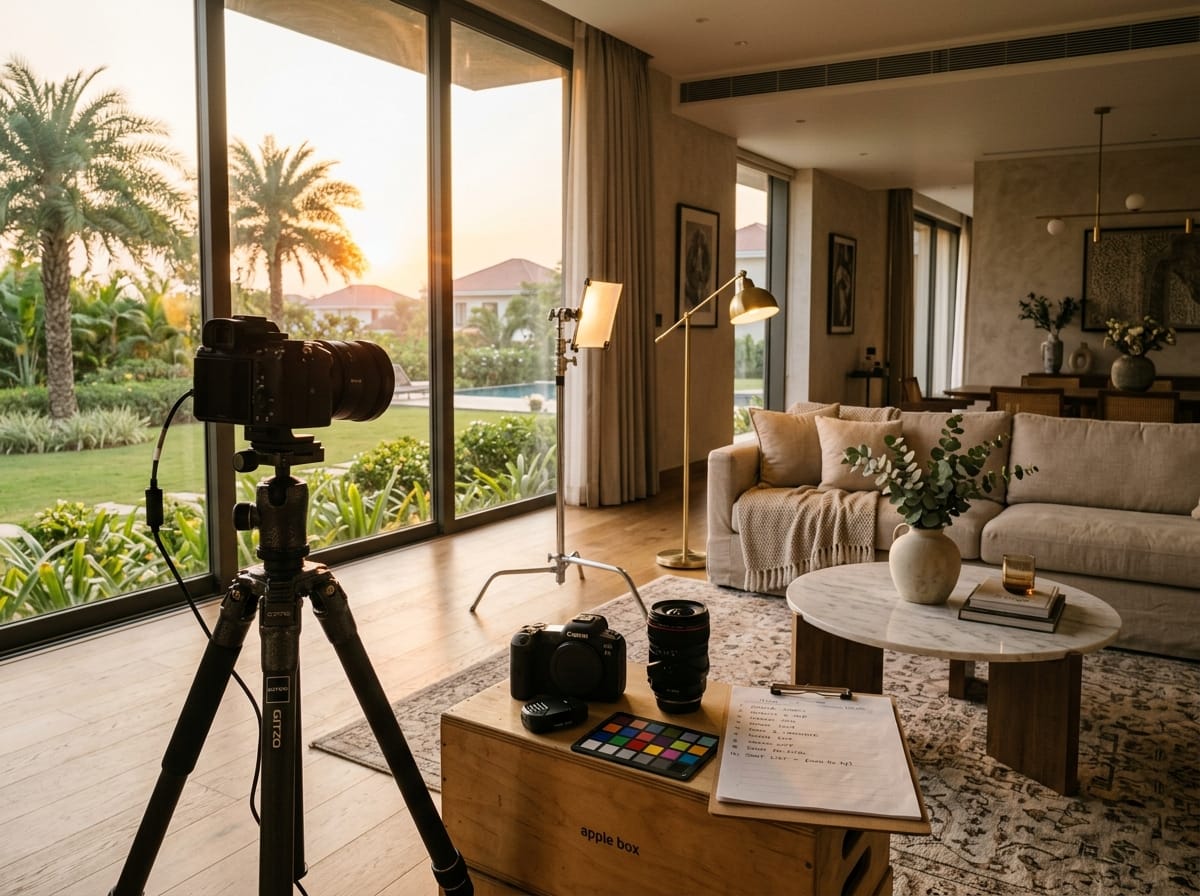
Real Estate Videography and Photography in India: A 2026 Guide for Developers and Agents
Table of Contents
India’s real estate market is one of the largest in the world. Mordor Intelligence values the India real estate market at USD 585 billion in 2026, projected to reach USD 926 billion by 2031 at 9.63% CAGR. The commercial segment alone is on track to grow from USD 53.5 billion to USD 116.3 billion at 16.8% CAGR. With Cushman & Wakefield reporting 22 million square feet of office leasing in Q1 2026 and Knight Frank tracking strong premium residential demand across NCR, Bengaluru, Hyderabad, and Mumbai, the visual content that sells the property has become the single most important marketing investment a developer or agent makes. This guide walks through what real estate videography and photography actually delivers in 2026, what a complete visual package looks like, what the work costs in India, and how to choose a studio that produces visuals that close deals.
Why Real Estate Video and Photography Are Now Mandatory
The case for professional real estate videography and photography is no longer up for debate. Five numbers from National Association of Realtors research, Knight Frank, and Cushman & Wakefield make the picture clear.
According to National Association of Realtors research, listings with video receive 403% more inquiries than photo-only listings. 3D virtual tours generate 87% more views, 73% of homeowners prefer agents who use video marketing, 58% of buyers expect virtual tours on listings, and homes with professional photography sell up to 32% faster. The numbers consistently come from primary survey data and have held steady across multiple methodologies.
For Indian developers and agents, three structural shifts make professional visuals more important than ever. The first is buyer behaviour. According to NAR research, 96% of buyers begin their property search online, and 51% use YouTube as their primary destination for property research. A property without strong video and photo simply does not surface in the first round of consideration.
The second is the rise of premium and luxury inventory in India. Knight Frank reports that homes priced above ₹1 crore now account for over half of total sales across major Indian cities, with luxury units above ₹5 crore holding a firm share in Mumbai, Bengaluru, NCR, and Hyderabad. Premium buyers expect premium visuals. A ₹3 crore Bengaluru villa cannot be sold with the same photography that worked for a ₹50 lakh apartment in 2018.
The third is NRI and remote-buyer demand. Indian developers are selling growing volumes of inventory to buyers who never physically visit the site before booking. NRI repatriation, return-migration to Bengaluru and Hyderabad, and remote investment flows mean that the visual asset is often the only thing the buyer sees before paying a token amount. This shift has made video walkthroughs, drone aerials, and 3D virtual tours non-negotiable for premium projects.
What a Real Estate Visual Package Should Include
A complete 2026 real estate visual package covers eight elements. Different property types need different combinations, but a serious developer or agent should know what each element does and when it earns its place.
- Hero stills. Twenty to forty professionally shot, edited, and colour-graded photographs covering exterior, interiors, amenities, and key feature spots. The headline asset on every listing site, brochure, and social post.
- Walkthrough video. A 60 to 120 second cinematic walkthrough showing the flow of the property, room by room, with smooth gimbal moves, considered framing, and music. The single highest-leverage video a listing produces.
- Drone aerials. Exterior aerial shots showing the property in its setting: roads, neighbourhood, green spaces, distance from landmarks. For projects in scenic locations (hill, beach, lake), drone is what closes the deal.
- 3D virtual tour. A Matterport-style 3D scan that lets buyers walk through the property remotely. According to NAR research, 3D tours generate 87% more views than photo-only listings. Critical for NRI buyers and remote investors.
- Floor plans. Clean, professionally drawn 2D and isometric floor plans with dimensions and labels. Often overlooked, but the asset buyers spend the most time on after the hero stills.
- Twilight and lifestyle photography. Twilight exterior shots and lifestyle photography of amenities (pool, gym, lobby, clubhouse). Premium projects routinely shoot at dusk and dawn for the deepest emotional impact.
- Reels and Shorts cutdowns. Vertical 15 to 30 second cutdowns of the walkthrough video, optimised for Instagram Reels, YouTube Shorts, and Meta paid ads. The single highest-organic-reach format for property marketing in 2026.
- Brochure and website-ready exports. Final files delivered in print-ready, web-optimised, and social-ready formats. A serious studio plans the export pipeline at brief stage, not after the shoot.
For most premium residential projects, the package needs all eight elements. For a 2 BHK rental listing, hero stills plus a short walkthrough is enough. The trick is matching the package to the property and the buyer it is being sold to.
What Real Estate Videography and Photography Costs in India in 2026
Real estate visual production in India in 2026 spans a wide range. A simple rental listing shoot can be wrapped in a few hours for ₹15,000. A premium developer launch with full visual package crosses ₹6 lakh. Working price tiers below.
The chart shows working cost bands across five common real estate visual project types in India in 2026. Pricing scales with property scale, deliverable count, and post-production load. Most premium developers running national campaigns commission visual packages in the ₹2 lakh to ₹4 lakh range, with multi-tower or large township projects crossing ₹5 lakh.
- Rental listing photo shoot (₹15,000 to ₹35,000). Half-day shoot, 15 to 25 edited stills, basic walkthrough video, drone exterior. Suits brokers, individual landlords, and small agencies listing rental inventory.
- Resale property full visual package (₹35,000 to ₹75,000). Full-day shoot, 25 to 40 edited stills, cinematic walkthrough video, drone aerials, basic floor plan. Standard for resale apartments and individual villa listings.
- Premium villa or apartment shoot (₹75,000 to ₹2 lakh). One to two day shoot, 40 to 60 edited stills, cinematic walkthrough, twilight photography, drone aerials, 3D virtual tour, professional floor plans. Standard for premium residential listings above ₹2 crore.
- Developer project launch package (₹2 lakh to ₹4 lakh). Two to three day shoot, full project coverage including model apartments, amenities, common areas, exteriors. Brand film, walkthrough films, drone, lifestyle photography, twilight, full virtual tour suite, brochure photography. The standard for developer launches in the ₹50 crore to ₹500 crore project range.
- Multi-tower commercial campaign (₹4 lakh to ₹8 lakh). Three to five day shoot across multiple buildings, brand film with talent, full art-directed lifestyle photography, premium drone work with permissions, complete deliverable package across web, brochure, hoardings, and social. Common for large township launches, premium commercial Grade A office buildings, and large hotel-resort properties.
Drone work is now standard inclusion in most developer packages and adds ₹15,000 to ₹50,000 depending on yellow-zone permission needs. For more on the drone side, see the drone videography in India guide.
What Distinguishes a Premium Real Estate Shoot
Premium real estate visuals look different from generic real estate visuals because of five specific craft choices. These are not luxuries. They are what makes the difference between a buyer scrolling past and a buyer stopping to look.
- Light direction matters more than light volume. Premium photographers shoot at golden hour, twilight, and blue hour for exterior shots, and use directional natural light for interiors. Flat overhead light kills depth and texture.
- Staging and styling. A property photographed empty looks abandoned. A property photographed with thoughtful staging (linen on the bed, fresh flowers, considered table settings, clean kitchens) sells. Premium shoots include a stylist on the day.
- Wide-angle but not distorted. Most generic real estate photography uses 12 to 14mm lenses that distort the room. Premium shoots use 16 to 24mm tilt-shift or carefully framed wide lenses that preserve true proportions.
- Cinematic camera movement in walkthroughs. Generic walkthroughs use bouncy gimbal moves and quick zooms. Premium walkthroughs use smooth, slow, deliberate camera moves with intentional reveals, allowing the architecture to speak for itself.
- Colour grading consistency. A premium shoot delivers all stills, video, drone, and lifestyle work with a consistent colour grade so the brochure, the website, and the Instagram feed all feel like one body of work.
The difference between a ₹35,000 shoot and a ₹2 lakh shoot is not better cameras. It is better light planning, better staging, better framing, and better post-production. The cameras both teams use are often the same.
How to Choose a Real Estate Videographer or Photographer
Six checks help separate a property visual specialist from a generic photographer with a wide-angle lens.
- Look at full property bodies of work, not single hero shots. One stunning photo proves nothing. Twenty consistent photos of the same property show whether the studio can sustain quality across an entire shoot.
- Watch the walkthrough video to the end. Real estate walkthroughs reveal craft. A studio that uses three quick cuts every five seconds is hiding poor blocking. A studio that holds a smooth shot for fifteen seconds is showing real cinematography.
- Confirm DGCA compliance for drone work. Ask for the operator’s Remote Pilot Certificate and the drone’s UIN. Drone-illegal footage cannot be used commercially under DGCA Drone Rules 2021.
- Check the post-production handling. Real estate photos almost always need HDR blending, sky replacement, exposure correction, and colour grading. Confirm whether the studio handles post in-house or outsources.
- Ask about turnaround. A reasonable turnaround for a residential shoot is three to seven working days for stills and ten to fourteen days for video. A studio quoting two to three weeks for stills is often a red flag.
- Ask about deliverable formats. A serious studio delivers print-ready, web-optimised, and social-ready exports as standard. A studio that delivers only one master file leaves the brand to figure out resizing.
For developer projects with multi-tower coverage, ask the studio to walk through their previous launch project from brief to delivery. The conversation reveals whether they understand the project management side of large real estate shoots, not just the cameras.
How Balladi Studios Approaches Real Estate Visuals
Balladi Studios approaches real estate the same way it approaches a brand film. The team treats every property as a story, scouts the location ahead of the shoot to understand light direction and the sequence of spaces, and plans the package around what the property is being sold to and who is buying.
Production is in-house from brief through final delivery. Stills, video, drone, and post-production are run by a single producer accountable end to end. The studio uses DGCA-compliant drone operators, maintains its own colour grading pipeline so video and stills feel like one consistent body of work, and delivers print-ready, web-ready, and social-ready files as standard.
Past work spans premium commercial environments such as Forum South Bangalore and brand visuals across Iron Hill, Embassy Academy, GKB Opticals, and United Telugu Kitchens. You can brief Balladi Studios here for a property project, or see the wider body of work on the creations page.
Frequently Asked Questions
How much does real estate videography and photography cost in India in 2026?
Real estate visual production in India ranges from ₹15,000 for a basic rental listing shoot to ₹8 lakh for a multi-tower commercial campaign. The most-booked tier is ₹35,000 to ₹75,000 for a resale property full visual package, and ₹75,000 to ₹2 lakh for a premium villa or apartment shoot.
Does video really sell properties faster?
Yes. National Association of Realtors research shows listings with video receive 403% more inquiries and sell up to 31% faster than photo-only listings. The lift is even stronger for premium and luxury properties, where buyers often make booking decisions based on the video walkthrough alone.
How long does a real estate shoot take?
A rental listing shoot wraps in three to five hours. A resale property full visual package takes a full day. Premium villa or apartment shoots take one to two days. Developer launch packages take two to three days, and multi-tower commercial campaigns often take three to five shoot days. Turnaround for stills is three to seven working days, and for video is ten to fourteen working days.
Do I need a 3D virtual tour?
Yes for premium residential properties above ₹2 crore, and for any project with significant NRI or remote-buyer demand. NAR research shows 3D tours generate 87% more views than photo-only listings, and 58% of buyers expect virtual tours on listings. For rental and budget resale, a strong walkthrough video and hero stills are usually enough.
Does Balladi Studios work with developers across India?
Yes. Balladi Studios takes on real estate visual projects across India, with travel and logistics scoped into the brief. The studio is Bengaluru-headquartered but ships projects in Mumbai, NCR, Hyderabad, Chennai, Pune, Kochi, and tier-2 cities regularly.
When is the best time to shoot a property?
Most exterior photography is shot at golden hour (early morning or just before sunset) and twilight (the 20 minutes after sunset, when the sky still has colour and the lights inside the property come on). Most interior photography is shot in mid-morning or mid-afternoon when natural light is at its softest. A serious studio plans the shoot day around these windows rather than fitting them around convenience.
References
National Association of Realtors. (2024). 2024 Profile of home buyers and sellers. NAR Research Group.
National Association of Realtors. (2025). 2025 NAR Technology Survey. NAR Research Group.
Mordor Intelligence. (2026). India real estate market size, share & 2031 growth. Retrieved from https://www.mordorintelligence.com/industry-reports/real-estate-industry-in-india
Mordor Intelligence. (2026). India commercial real estate market size & share 2026–2031. Retrieved from https://www.mordorintelligence.com/industry-reports/commercial-real-estate-market-in-india
Mordor Intelligence. (2026). India residential real estate market size, analysis & share report 2031. Retrieved from https://www.mordorintelligence.com/industry-reports/residential-real-estate-market-in-india
Cushman & Wakefield. (2026). India outlook 2026: A comprehensive real estate perspective. Retrieved from https://www.cushmanwakefield.com/en/india/insights/india-outlook
Cushman & Wakefield. (2026). Q1 2026 Office MarketBeat report. Retrieved from https://www.cushmanwakefield.com/en/india/news/2026/04/india-office-market-growth-in-q1-2026
Knight Frank. (2026). India real estate research: Residential and commercial market analysis. Knight Frank Research.
Let’s Talk
If you have a property project in mind, write to hello@balladistudios.com or send a brief through the connect page. You can also see recent work on the creations page.